
Electrostatic discharges rarely announce themselves. A sensitive component can survive a visible spark and still fail weeks later in the field, after a latent defect propagates. For a production or quality manager facing recurring component losses, the question is no longer whether to deploy ESD controls, but how to combine them coherently across an entire work area.
An effective ESD Protected Area (EPA) rarely relies on a single barrier. Rigid packaging, ionization and grounding each address a different failure path: physical shielding during transport, charge neutralization on insulators, and charge dissipation during handling. This article structures these three levers into one integrated strategy aligned with recognized ESD standards.
Direct answer: A robust ESD strategy combines rigid conductive packaging to shield components during transport and storage, grounding to drain charges from workstations and operators during handling, and ionizers to neutralize charges on insulators that cannot be grounded. Each layer covers a failure path the others cannot address, and compliance is verified against standards such as IEC 61340-5-1 or ANSI/ESD S20.20.
Why ESD protection requires a multi-layer strategy
A single control measure cannot cover every electrostatic failure path in a production area. Shielding bags protect a board in transit but do nothing against a plastic tray charged near the assembly point. A grounded wrist strap drains an operator but does not neutralize insulating packaging materials. The ESD (electrostatic discharge) risk is distributed across transport, storage and handling, so controls must be too.
The damage itself is often invisible. According to the international standard IEC 61340-5-1:2024, an ESD control program must protect components sensitive to voltages as low as 100 V for the Human Body Model (HBM) and 200 V for the Charged Device Model (CDM). These thresholds are well below the perception threshold of a human operator, which means a destructive event can occur without any visible or felt discharge.
Latent defects compound the problem. A component weakened by a sub-threshold event may pass final test and fail later in use, generating warranty costs and field returns that are difficult to trace back to the production line. This is why a strategy based on combination, not substitution, is the editorial angle this article defends.
The three complementary roles at a glance
- Rigid packaging shields components from external fields during transport and storage.
- Grounding dissipates charges from operators, benches and tools during handling.
- Ionization neutralizes charges on insulators that cannot be electrically bonded.
A fragmented approach leaves predictable gaps. Consider a scenario where sensitive boards are stored in high-quality shielding bags, transported correctly, and then opened on a workbench next to an insulating plastic bin that has accumulated several kilovolts of surface charge. The shielding did its job, the grounding of the operator is correct, yet the component is exposed to a charged insulator at close range. Only an ionizer, or physical separation, addresses this failure path. Comprehensive ESD Protection solutions, such as those documented by specialists like ESD Protection, are typically designed around this layered logic rather than a single product category.
What role do rigid ESD packaging and EPA grounding play?
Rigid ESD packaging and EPA grounding are the two permanent, passive controls that frame the life of a sensitive component. Packaging protects it when nobody is handling it; grounding protects it when somebody is. Understanding this division clarifies which investment addresses which risk.
Rigid packaging: physical shielding and protection
Rigid conductive or shielding packaging — totes, trays, bins, boxes — provides two combined functions. Mechanically, it protects the component from shocks, vibration and crushing. Electrically, when it includes a conductive or dissipative layer, it forms a Faraday-type barrier that attenuates external electrostatic fields and prevents charge transfer to the contents.
This layer matters most during transport between workstations, inter-site shipment, and storage. A component sealed in appropriate rigid packaging can cross a non-controlled area without being exposed to the ambient electrostatic environment. The packaging effectively extends the protection perimeter of the EPA beyond its physical boundaries.
Grounding: dissipation during active handling
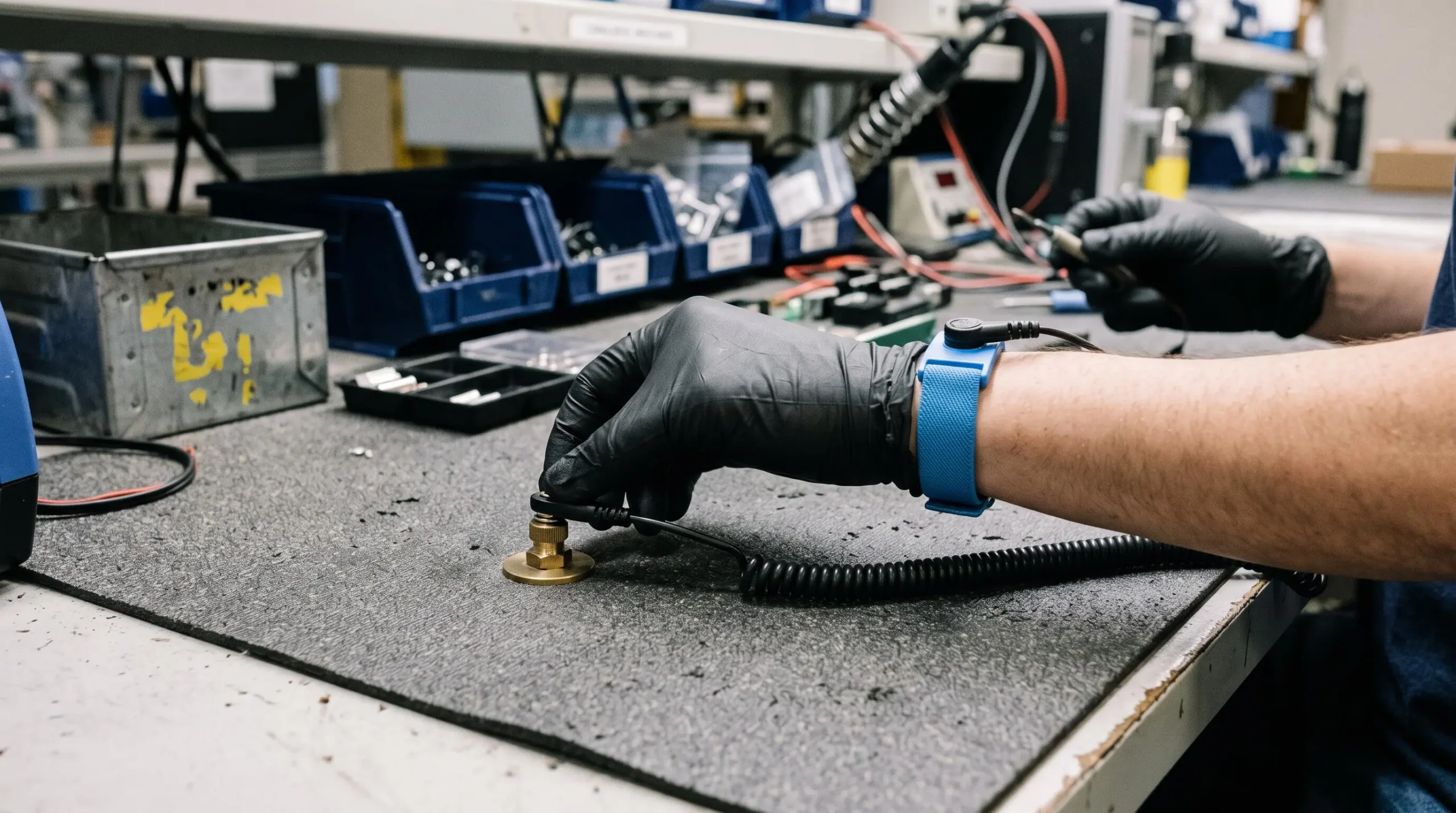
Grounding, or earthing, is the backbone of the EPA itself. Workbenches, floor mats, chairs, tools and personnel are all connected to a common ground reference point through dissipative paths. Wrist straps bond the operator; conductive flooring and footwear bond people in motion; bench mats and ground cords bond work surfaces and equipment.
Typical placements include manual assembly benches with plastic carriers, visual inspection stations handling boards on insulating fixtures, cleanroom zones where conductive flooring is limited, and areas with directed airflow where particulate control already requires overhead equipment. The choice between overhead ionizers, benchtop units or nozzle ionizers depends on the geometry of the workstation and the exposure time of the component.
Ionization is a complement, not a substitute: an ionizer does not replace grounding or shielding. It only addresses the specific case of insulators that cannot be removed or electrically bonded. Deploying ionizers without proper grounding does not create a compliant EPA.
Ionizers also require their own verification regime. Discharge time and offset voltage must be measured periodically with a calibrated charged-plate monitor. An unbalanced ionizer — generating more positive than negative ions, or the reverse — can actively charge the surfaces it is supposed to neutralize, turning a protection device into a risk factor.
How to build a compliant and verifiable ESD program
A compliant ESD program is not a collection of products; it is a documented process. The two reference frameworks are IEC 61340-5-1 at international level and ANSI/ESD S20.20 in North America. Both describe the administrative and technical requirements for an ESD control program, including grounding, EPA definition, packaging and marking. A supplementary resource, the NASA handbook for ESD control implementation, illustrates how these requirements are operationalized in a demanding industrial context.
Building a verifiable program typically follows four stages.
- Map the EPA and classify risks
Identify each zone where ESD-sensitive devices are handled, stored or transported. For each zone, document the components involved, their sensitivity level, the materials present (including insulators) and the handling steps.
- Select controls per zone
Assign the appropriate combination of packaging, grounding and ionization. A storage area needs rigid shielding packaging and minimal grounding; an assembly bench needs full grounding plus ionization if insulators are present; a shipping zone needs packaging integrity controls.
- Define verification checkpoints
Establish measurable criteria: wrist strap continuity testing before each shift, periodic resistance measurements on flooring and benches, ionizer balance and discharge time checks, packaging integrity inspection on receipt and dispatch.
- Document, train and audit
Keep calibration records for instruments, measurement logs for each checkpoint, and training records for every operator entering the EPA. Schedule internal audits and corrective action tracking to demonstrate ongoing compliance.

Compliance also means dealing honestly with change. A new product with different ESD sensitivity, a new workstation layout, a change in packaging supplier, or the introduction of a new insulating material all require revisiting the risk map. A program that is written once and never updated loses its verifiable character within a few months of production evolution.
Standards verification: the exact edition, publication date and clause numbering of IEC and ANSI/ESD standards evolve. Any internal document, procurement specification or audit checklist should cite the current edition verified directly against the publishing organism, not a secondary source.
For teams building or upgrading a protected area, the broader context of industrial enclosures and physical containment also plays a role in protecting critical operations. A complementary perspective on metal enclosures for critical operations can help situate ESD controls within an overall equipment-protection strategy.
Key takeaways for an integrated ESD approach
The three levers of an effective ESD strategy are not interchangeable. Rigid packaging isolates and shields during transport and storage. Grounding drains charges from everything that can be electrically bonded during handling. Ionizers neutralize charges on insulators that neither packaging nor grounding can address. Removing any one layer leaves a predictable gap in the protection chain.
Compliance anchors the program in verifiable practice. Reference standards define the thresholds, the test methods and the documentation expected. Internal audits, calibrated instruments and operator training translate those requirements into daily reality. Without this verification loop, even well-equipped areas drift toward non-conformity over time.
What is the difference between rigid ESD packaging shielding and EPA grounding?
Shielding packaging acts as a Faraday-type barrier that attenuates external electrostatic fields and protects a component when it is not being handled, typically during transport and storage. EPA grounding drains charges from benches, operators and tools during active handling. The two controls address different moments in the component’s lifecycle and are complementary rather than redundant.
When is ionization essential instead of grounding alone?
Ionization becomes essential whenever process-necessary insulators are present near ESD-sensitive components and cannot be removed. Grounding cannot dissipate charges from insulators because they have no conductive path. ANSI/ESD S20.20 indicates that for an insulator closer than 30 cm to a sensitive component, either physical separation or ionization is required.
Which standards govern an EPA?
The two main reference standards are IEC 61340-5-1 at international level and ANSI/ESD S20.20 published by the ESD Association. Both describe the administrative and technical requirements for an ESD control program covering grounding, EPA definition, packaging and marking. Supplementary technical reports, such as IEC TR 61340-5-2, provide implementation guidance.
How can an ESD program be verified over time?
Verification relies on periodic measurements with calibrated instruments: wrist strap testers, resistance meters for flooring and benches, charged-plate monitors for ionizers, and field meters for insulators. These measurements must be documented, compared against the thresholds defined in the applicable standard, and completed by regular internal audits and operator training records.
The practical next step for a production or quality manager is a structured self-assessment of the current area against the three layers: inventory the packaging actually in use, map the grounding paths and their verification status, and identify every insulator present near sensitive components. This baseline reveals where investment produces the highest marginal gain in protection, and keeps the program grounded in the specific reality of the workshop rather than in a generic specification.