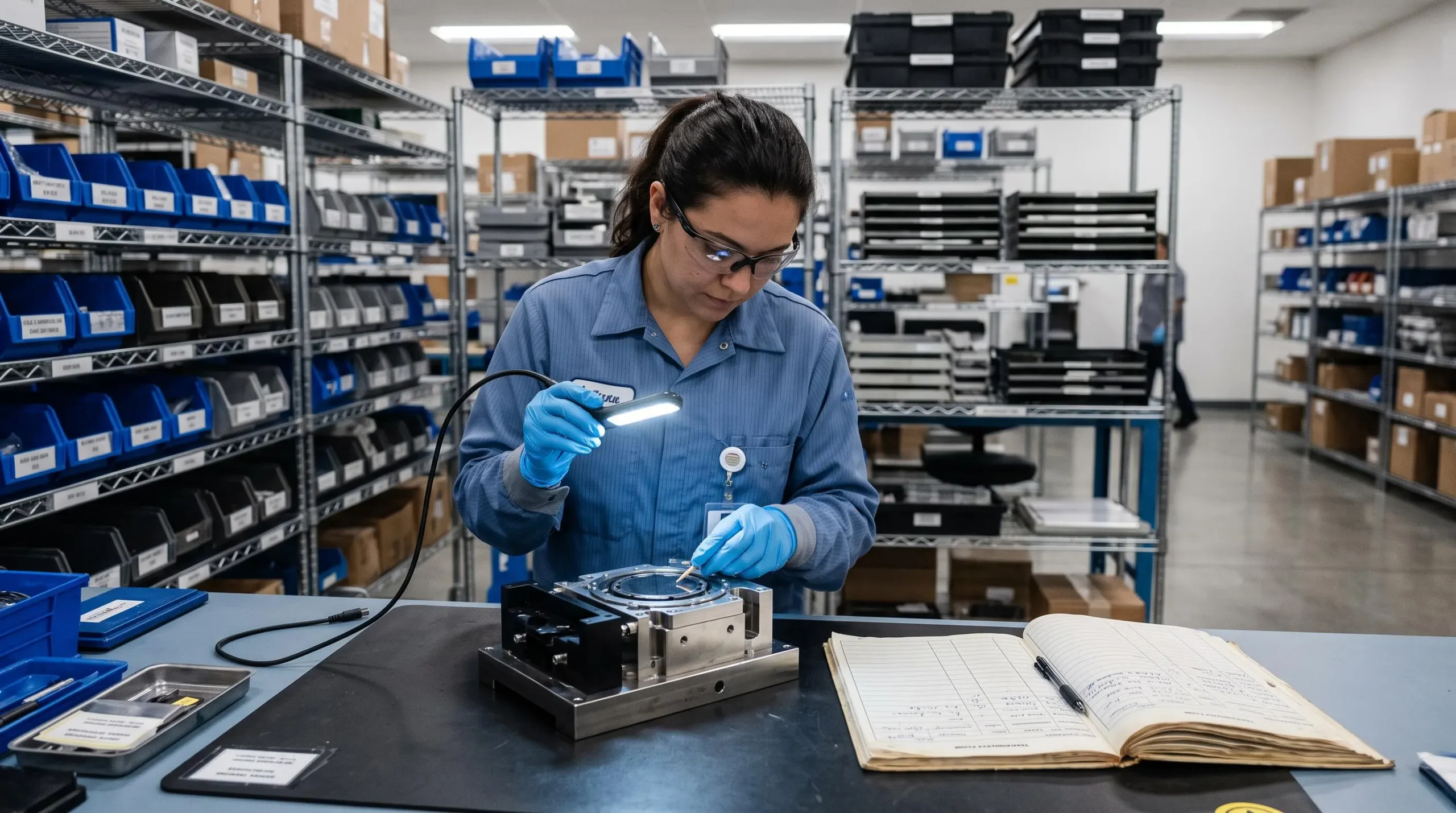
Sourcing spare parts for KLA Tencor metrology and inspection tools outside the OEM channel is rarely a matter of preference: legacy platforms, long OEM lead times and pressure on uptime push most fabs to evaluate second-source options. The real question is not whether to buy alternative parts, but how to prove — before installation and after — that a given part is authentic, compatible and performing as expected. Treating this as a method rather than a matter of trust is what turns an uncertain aftermarket purchase into a controlled, auditable sourcing decision.
Three questions are too often conflated: is the part authentic (traceability), is it compatible (technical fit with the exact KLA platform), and does it perform (validated in production)? A part can pass one test and fail another. Each requires its own verification protocol, and each has its own set of acceptable evidence.
Verification-first summary for KLA second-source sourcing
- Separate three questions: authenticity, compatibility, performance — each demands its own evidence.
- Authenticity is proven by documented traceability, markings and applicable industry standards, not by supplier reputation alone.
- Compatibility and performance require post-installation qualification against the tool’s baseline specifications.
- Legacy KLA platforms need dedicated sourcing logic: obsolete parts, longer verification, safety stock for critical references.
- A defensible sourcing decision leaves an audit trail — documentation, tests, supplier records — usable in internal reviews.
Second-source, reconditioned, counterfeit: telling KLA part categories apart
Before applying any verification method, the vocabulary itself must be unambiguous. Sales language often blends terms that carry very different legal, technical and risk implications. For KLA Tencor spare parts specifically, three operational categories should be kept separate.
What distinguishes a second-source, reconditioned and counterfeit part?
A second-source part is a component supplied outside the original OEM distribution channel. It can be new-old-stock, sourced from independent distributors, or manufactured by an alternative producer. Its legitimacy relies on documented origin and, when relevant, compliance with industry standards for independent distribution.
A reconditioned (or refurbished) part is a used component that has been inspected, cleaned, repaired or partially replaced to return to a defined functional state. Legitimacy here depends on the reconditioning process itself: what was tested, what was replaced, against which reference specifications, and by whom.
A counterfeit part is a component misrepresented as to its identity, origin, condition or performance. According to the SIA report on counterfeit sourcing, components reported through the industry’s Government-Industry Data Exchange Program consistently involve purchases from the open market — independent distributors, brokers and online platforms not authorized by original manufacturers — with re-marking techniques used to hide age or non-conformity.
Practical implication: a legitimate second-source or reconditioned part can be a rational sourcing choice; a counterfeit part is by definition unacceptable. The verification method must be able to sort the first two from the third — before purchase.
Why does this matter for legacy KLA platforms?
For legacy KLA Tencor tools still critical to production, OEM support is often reduced, discontinued or subject to long lead times. Second-source and reconditioned parts frequently become the only viable path to keep those tools running. That situation raises the stakes of verification: the likelihood of encountering obsolete stock, re-marked components or improperly reconditioned modules increases precisely where verification is hardest.
Specialized aftermarket suppliers position themselves on this segment. Among them, Eumetrys Spare Parts communicates a focus on KLA Tencor parts, including references for legacy platforms — a positioning that illustrates the type of specialization worth looking for, and which must be evaluated with the same verification rigor applied to any second-source supplier.
How do you verify the authenticity of a second-source KLA part before purchase?
Pre-purchase authenticity verification rests on documentary evidence, physical inspection criteria and supplier credibility. None of these three pillars is sufficient on its own; combined, they form a repeatable checklist that can be applied to any incoming quote.
Which documentation and traceability should the supplier provide?
A credible second-source supplier should be able to document, on request, the origin and handling history of the part. The minimum expected file includes:
- Original manufacturer identification (part number, revision, date code when applicable).
- Chain of custody: previous owner or source, receiving date, storage conditions.
- Inspection or test reports carried out by the supplier, dated and signed.
- For reconditioned parts, a statement of work describing what was inspected, replaced or repaired, against which reference.
- Packaging and ESD handling records consistent with the part’s sensitivity.
A supplier unable — or unwilling — to produce this documentation is a decision signal in itself, independently of the price offered.
Which standards and markings should be checked?
Two references are particularly relevant when evaluating an independent distribution channel for electronic and electromechanical parts. The AS6081 counterfeit parts standard overview published by the ANSI National Accreditation Board describes SAE AS6081A-2023, which establishes requirements to mitigate the risk of buying, receiving and selling counterfeit EEE parts on the open market, and is specifically aimed at independent distributors rather than OEMs.
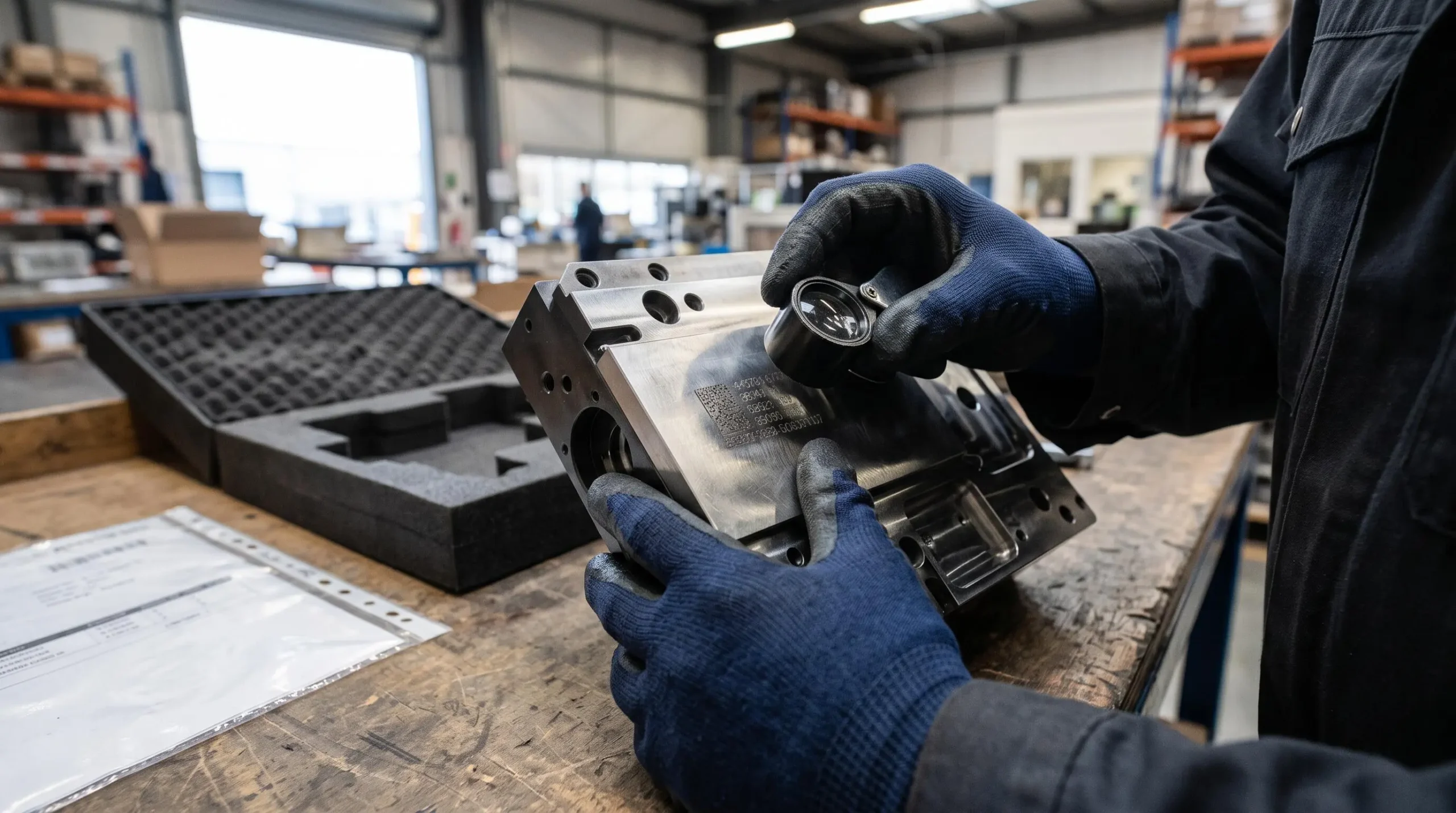
For physical inspection of markings, the NASA visual counterfeit inspection guide illustrates, based on the IDEA-STD-1010-A standard, indicators used to detect re-marked or resurfaced components — for example, unnatural surface finishes described as “blacktopped” or ghost markings visible under angled light. These indicators are relevant for board-level components integrated into KLA modules; they do not substitute for performance validation, but they filter out obvious counterfeits early.
Which red flags should trigger rejection or deeper review?
Certain signals, taken together, indicate that a deeper investigation — or outright rejection — is warranted before any purchase order:
- Inconsistent markingsFonts, alignment or engraving depth that differ across identical parts from the same alleged batch.
- Missing or vague documentationNo dated inspection report, no traceable origin, or generic certificates unrelated to the specific part.
- Price significantly below marketAn offer well under prevailing aftermarket levels for the same reference and condition, without documented justification.
- No AS6081-aligned processIndependent distributor unable to describe an incoming inspection or counterfeit-avoidance process.
- Refusal of physical inspection or additional testingSupplier declines pre-shipment inspection, sample testing or extended acceptance conditions.
Validating the performance of a non-OEM part in a KLA Tencor tool
Passing authenticity checks does not mean a part will perform correctly on a specific KLA platform. Compatibility and performance are validated after installation, through a structured qualification aligned with the tool’s baseline specifications. This is where paperwork ends and metrology begins.
Which compatibility tests should precede full qualification?
Before returning the tool to production, a graduated test sequence limits exposure to unexpected behavior. A pragmatic staging includes:
- Mechanical and interface checks: dimensional conformity, connector fit, mounting clearances against the tool’s assembly reference.
- Power-on and self-diagnostics: verification that the tool’s built-in tests recognize the module and report no fault.
- Functional test: execution of the part’s core function under controlled conditions (no production wafer at risk).
- Reference measurement: comparison of tool outputs on a known reference against the pre-replacement baseline.
Compatibility is confirmed only when all four stages pass. A part that clears mechanical fit but shifts reference measurements outside tolerance is not compatible for that tool, regardless of what the datasheet claims.
What does a post-installation qualification look like on a legacy platform?
On a legacy KLA metrology or inspection tool, the qualification protocol must reflect the platform’s actual production role. The following sequence is representative rather than exhaustive: any given fab may add steps based on internal quality procedures.
| Stage | Purpose | Acceptance criterion |
|---|---|---|
| Baseline capture (pre-replacement) | Record tool performance before intervention | Documented reference dataset on standard artifacts |
| Installation and self-test | Confirm hardware/software integration | No fault reported by tool diagnostics |
| Reference measurement | Compare output against baseline | Deviation within tool’s documented tolerance |
| Repeatability run | Verify measurement stability over multiple cycles | Statistical variation consistent with baseline |
| Production ramp under monitoring | Detect drift under real workload | No abnormal trend over a defined observation window |

Legacy platform vigilance: on tools where OEM software support is limited, self-diagnostics may not detect subtle drifts introduced by a non-OEM part. Independent reference measurements against golden artifacts are essential — a “green” diagnostic screen is not, on its own, a qualification result.
Building a sourcing strategy that reduces downtime
Unit-level verification is necessary but not sufficient. Sustained uptime on a fleet of KLA tools depends on a broader sourcing strategy: how suppliers are selected, how critical parts are stocked, and how response times are secured before an actual failure occurs.
Which criteria should drive supplier selection?
A repeatable supplier evaluation grid helps compare offers on more than price and stated lead time. Weighting depends on each fab’s constraints, but the following criteria form a defensible baseline:
| Criterion | What to look for | Why it matters |
|---|---|---|
| Traceability practices | Documented origin, chain of custody, inspection records | Foundation of authenticity verification |
| Alignment with anti-counterfeit standards | Processes consistent with references such as AS6081 | Filters out unstructured independent distributors |
| Testing and reconditioning capability | In-house or partnered facilities with documented protocols | Direct impact on part reliability post-installation |
| Coverage of legacy platforms | Catalog depth on obsolete KLA references | Critical when OEM channel no longer supports the tool |
| Response and shipping lead times | Documented quote and dispatch commitments | Direct lever on mean time to repair |
| Warranty and return policy | Clear conditions on defective parts and non-conformity | Defines the fab’s residual risk on each purchase |
How should safety stock be structured for critical parts?
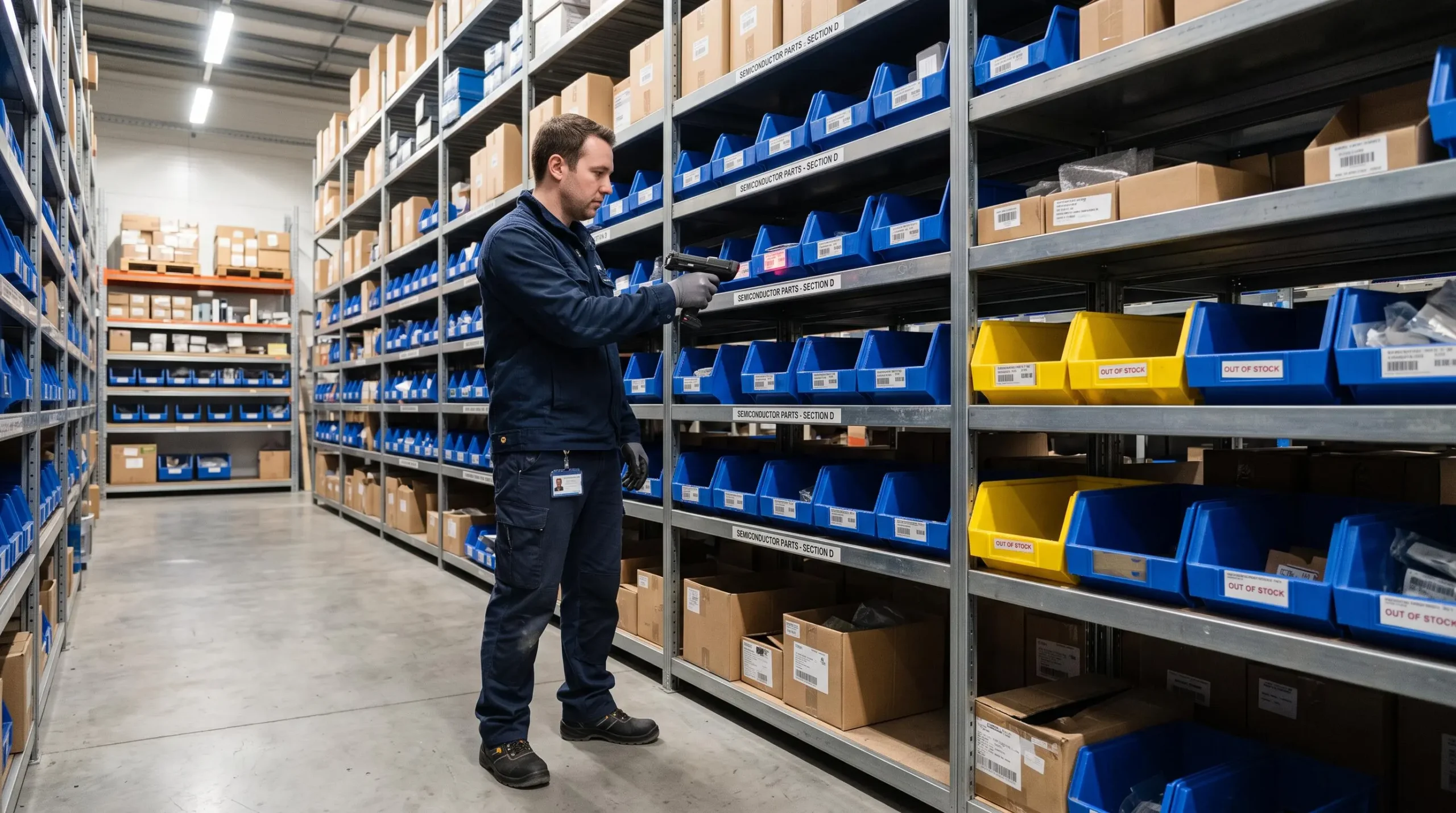
Safety stock is the operational counterpart to supplier selection. Even the fastest supplier cannot compete with a part already on the shelf. A structured approach avoids both over-stocking and dangerous gaps:
- Criticality mapping: classify parts by tool criticality, historical failure rate and OEM lead time.
- Reorder thresholds: set minimum stock levels for high-criticality, long-lead references.
- Dual sourcing where possible: identify at least one qualified second-source alternative for each critical reference.
- Periodic review: audit stock against actual consumption and platform roadmap changes.
Hypothetical scenario
A maintenance manager operates two legacy KLA inspection tools identified as production-critical. Historical data shows recurrent failure of a specific handler module every 18 to 24 months, with OEM lead times exceeding six weeks. By pre-qualifying a second-source supplier on that reference, running a full post-installation qualification on the first replacement, and keeping one validated spare in safety stock, the team converts a potential multi-week production stop into a scheduled swap. The value is not in the individual purchase but in the qualified sourcing chain established before the failure.
Which reflexes secure your KLA parts purchases in the long run?
Long-term security relies less on isolated decisions than on repeatable reflexes: the same checklist applied to every purchase, the same documentation kept for every part, the same questions asked to every supplier. Codifying these reflexes turns individual expertise into a process that survives team changes and audits.
Which documents should be kept for every second-source purchase?
For each part received and installed, the following records should be archived — digitally or physically — and linked to the tool history:
- Supplier quote and purchase order with the exact part reference and revision.
- Supplier-provided documentation: origin, inspection report, reconditioning statement of work when applicable.
- Incoming inspection record performed by the fab (markings, packaging, visual checks).
- Installation record and post-installation qualification results.
- Any non-conformity, deviation or warranty claim raised on the part.
This file is what allows the fab to respond to an internal audit or a customer quality inquiry without reconstructing history from memory.
- If documentation is complete and inspection passes:Proceed with installation and run the full post-installation qualification.
- If documentation is partial but inspection passes:Request missing records before installation; do not qualify on trust.
- If inspection reveals inconsistent markings or physical anomalies:Quarantine the part, notify the supplier, and treat as a potential counterfeit case.
- If tool is production-critical and no fallback exists:Do not skip qualification stages under time pressure; escalate to prioritize a validated alternative.
Looking beyond spare parts management, sustained tool performance also depends on the wider evolution of measurement technology. Readers responsible for equipment reliability may find useful context in next-generation industrial sensors, which frames how sensor innovation is reshaping industrial monitoring practices.
Can second-source parts void an OEM warranty or support contract?
The impact on OEM warranty or support depends on the specific contract in force with the equipment manufacturer, not on a general rule. The relevant verification is contractual: review the tool’s support agreement, identify clauses covering non-OEM parts, and document the qualification performed on any second-source component. This turns a compliance question into an evidence question rather than a matter of hope.
How can obsolete parts for legacy KLA platforms be sourced reliably?
Obsolete parts typically come from independent distributors, specialized aftermarket suppliers or reconditioning workshops. Reliability rests on two conditions: the supplier operates within a documented anti-counterfeit process aligned with recognized standards such as AS6081, and the fab performs a full post-installation qualification on every unit. On legacy platforms, no shortcut on qualification is acceptable.
How can second-source part compliance be documented for an internal audit?
Auditors typically look for a traceable chain: purchase order, supplier documentation, incoming inspection, installation record and qualification results, all linked to the specific tool and serial-tracked reference. Keeping this file per part and per intervention converts a defensive posture into a factual response backed by contemporaneous records.
How can counterfeit semiconductor spare parts be spotted before installation?
Visual and documentary indicators — inconsistent markings, resurfaced areas, missing traceability, unrealistic pricing — provide an initial filter, as illustrated by public inspection resources such as those published by NASA. These indicators are necessary but not sufficient: the definitive verification is the combination of documented origin, alignment with independent-distribution standards, and successful post-installation qualification.
Verifying authenticity and performance in second-source KLA spare parts is ultimately a discipline: separating the three questions of authenticity, compatibility and performance, applying the same checklist to every purchase, and keeping the evidence that turns a sourcing decision into an auditable one. Fabs that codify this discipline gain what unverified sourcing cannot deliver — a defensible, repeatable process that reduces downtime without transferring the risk to the production floor.